Runaways Advertisement, New Orleans Jail, 1845 Historical Newspaper Advertisement
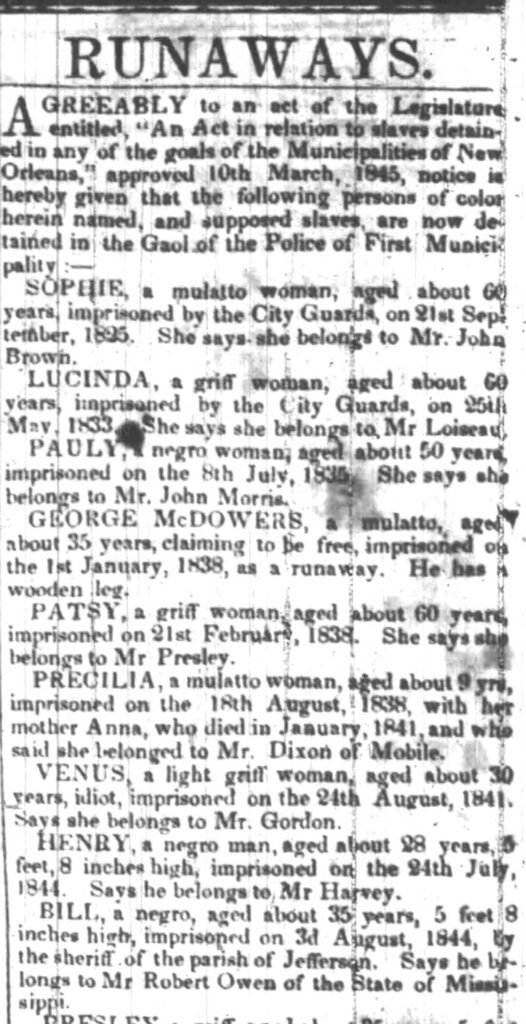
Runaways Advertisement, New Orleans Jail, 1845; The Courier (New Orleans, Louisiana), April 29, 1845.

Published in 1845, the Courier advertisement functions as institutional discourse that
assists in the surveillance, classification, detention, and recovery of enslaved individuals.
Through legal, economic, racial, and bureaucratic language, the notice normalizes human
ownership while presenting slavery as an ordinary administrative practice (The Courier, 1845;
Fairclough, 1992, 1995; Machin & Mayr, 2023).


Absence-in-Presence and Presence-in-Absence Original Visual-Theoretical Framework Artifacts

Original Methodological Frameworks Presence-in-Absence Hargett 2024a

Original Methodological Frameworks Absence-in-Presence Hargett 2024b


ORIGINAL DIASPORIC MAROON MEMORY THEORY; METHODOLOGIES OF DIGITAL DISCOURSE TECHNO-VERNACULAR DISCOURSE CONCEPTS

DECOLONIAL Algorithmic nodes & infrastructure Theoretical Foundations

Feature “Conscious Collective” defined by Prof. M. E. Hargett, M.A. Carl Jung’s “Collective Unconscious”
DomainConscious shared awareness, beliefs, and values.Unconscious inherited psychic structure.
OriginAcquired through social interaction, communication, and shared experiences within a specific group.Innate, inherited, universal structure of the mind, present from birth.
NatureExplicit, deliberate, intentional (e.g., a social movement, community).Instinctual, primordial, autonomous patterns (archetypes) that operate outside conscious control.
PurposeTo achieve shared, explicit goals and collective action in the external world.To autonomously organize individual experience and provide universal templates for understanding the world (often surfacing in dreams, myths, and art).
© Assoc. Prof. M. E. Hargett, M.A. 2025–2030